Sunday, 2 October 2011

Tinker, Tailor, Treachery & Treason.....


"A desk is a dangerous place from which to view the world" (John Le Carré)

The mysterious machinations of the invisible entity known as the intelligence service has had an avalanche of interpretations in literature and pop culture since the denouement of the Second World War. From early genre pieces such as Hitchcock's The 39 Steps to Ian Fleming's never-ending Bond saga, the spy-game has certainly never wained in the eyes of Hollywood. One of the greatest writers of this generation and a former intelligence officer, John Le Carré, however, sought to demonstrate just how far from the truth these commentaries on espionage really were. Somewhat ironically his stories proved to be much more fascinating and absorbing,  displaying with tactile ease how a bottle of Bollinger and a DB5 were no match for backroom betrayals and a stack of manilla folders.

In particular, Le Carré's much-beloved Karla Trilogy played upon people's natural distrust towards their fellow companions, whilst also commenting on the detritus that was MI6 in the wake of the Cambridge Five scandal. The first title within the trilogy, Tinker Tailor Soldier Spy, introduced the literary world to the reserved and private character that was George Smiley: A beacon of obstinate conservatism who never wavered from his course of action, yet was as flawed and fractured as the decaying walls he was confined to. His character traits certainly marked a departure from the bravado and indestructibility of one 007, as did the narrative. 

Set against the backdrop of a London on the precipice of austerity and disillusionment, Tinker transported us into a world of corridors and archives. After a botched snatch job in former Communist Czechoslavkia, there is a shift in power at the top of the 'Circus' (codename for MI6). 'Control', the usurped former leader, is left to rot in a hospital ward and his closest advisor, George Smiley, entertains himself by visiting the local opticians to receive a new pair of austere spectacles. However, after a Government minister receives a tip-off that there is a Russian mole in the highest echelon of the secret service, Smiley is called out of his forced retirement to uncover a world of treachery, heartache and warped morality.


Tobacco smoke seems to pervade every sequence in 'Tinker'.

It makes for a compelling read and it relieves me to say it makes for an incredible film also. From the outset, it's quite obvious the ensemble within this film is probably one of the greatest parades of British talent ever to grace the silver screen. Oldman performs in a stunning turn of character as a man who's solemnity and grace betray his despise for the deluded individuals around him, as well as the people who could be considered a part of his tortuous and lonely private life. The modern-day Sherlock Holmes, Benedict Cumberbatch, pulls in a fantastic performance as Smiley's most-trusted aide and Tom Hardy displays effortlessly, yet again, why he is Britain's answer to the late Marlon Brando.

I could parrot on endlessly as to why these heavyweight actors are utterly faultless during the running time but ultimately this film relies on atmospheric tension to drive the narrative forward. To some extent, you don't even need to follow the story in order to realise you are watching a director who is fast-becoming one of the world's finest auteurs. Tomas Alfredsen's previous work, Let the Right One In, was a stunning achievement in cinematic atmosphere and Tinker is no different in that respect. Blending the drab monotone palet of early 70s interior design, with the pervading hues of perpetually swirling cigarette smoke and you have an atmosphere which reflects the mood of the period. The backdrop also acts as a visual metaphor for many of the complex facets conveyed by these despondent and isolated individuals. It could be argued that this atmosphere reflects Britain's role during the Cold War period: A country isolated from the world stage, whose only call to perform was to act as the dispensable middle man. 


"Bloody call centres!!!...."

Aside from atmosphere, Alfredsen brings nuance, grace and, above all, patience in his camerawork. Rather than delve into self-indulgent sweeping shots and ferocious editing, which seems to be a common denominator within every modern-day thriller, he keeps the camera fixed and gives his ensemble time to breathe. Camerawork can be a key tool in a director's arsenal to develop themes. For instance, by  introducing multiple angles, accompanied by frenetic editing, an audience can potentially "get caught up in the action". However, by maintaining simple shots, Alfredsen clearly wanted to generate a different kind of effect: Tension through expression. As an audience we are forced to evaluate each glance and detail in the characters' facial expressions. At multiple points, you're attempting to deconstruct each fleeting look and question a character's motive, which generates this organic sense of suspicion and uncertainty. In essence, you form part of the atmospheric tension through your own imagination, which only adds to the sense of uncertainty surrounding the mole's identity. It is, by far, this film's greatest achievement and is a textbook lesson in direction and action.

As you no doubt have guessed I love this film. The late Harry Potter series may have been testament to the dedication and logistical talent within the British film industry, but Tinker Tailor Soldier Spy is a measure of pure British thespian talent. Ironically, a film about treachery and deceit within Britain, is one which makes me proud to be living in this country. However, lest we not forget the source of this fantastic film: David John Moore Cornwell (a.k.a. John Le Carré). A fine author who once said "A desk is a dangerous place from which to view the world." It's just a shame he failed to mention that a desk is also a marvellous place from which to create a thoroughly captivating one. 

Sunday, 21 August 2011

Chimps & Coup D'etats: A Review of "Rise of the Planet of the Apes"


"The road to hell is paved with good intentions." (Old Proverb)

Revolutions, be it the bloody overthrow of Batista in Cuba or the signing of the Declaration of Independence, have spawned from humans innate desire to taste and savour two tantalising pillars of humanity: Freedom and liberty. In today's democratic society we simply tend to take these for granted. You only have to look back at the recent events within the Middle East though to witness how these fragile proponents of free will can be crushingly extinguished or set alight from a faint spark of hope.

This whole notion of fighting for one's freedom through adversity and hatred forms the core of Rupert Wyatt's Rise of the Planet of the Apes. However, to reduce this film to a simple political philosophy is to serve it a great injustice. Tackling themes from animal cruelty and the dual nature of captivity through to the role of family, bereavement and the nature versus nurture debate, ROTPOTA is simply in a class of its own. To steal a word, which has been emblazoned on the bottom of every blockbuster poster this summer, Wyatt's film is a marvel to behold.

Serving as a prequel to the beloved 1968 sci-fi adventure Planet of the Apes starring Charlton Heston, ROTPOTA is set in present day San Francisco. Will Rodman is a geneticist on the verge of a medical breakthrough which will revolutionise modern medicine and rid the world of Alzheimer's disease. Motivated by purist thoughts and a need to stop his father from succumbing to the very illness, which he is seeking to eradicate, Will decides to conduct clinical trials on primates. Through a climactic opening act, which depicts the harsh environment of captivity, the tragic Doctor is forced to adopt Caesar; an ape, whose mother was killed in attempting to protect her offspring at the medical facility. Will forges an unlikely paternal relationship with the small chimp and begins to realise that Caesar displays an advanced form of intelligence, as a result of inherent genes passed on from his mother, who was subject to the clinical trials. Through Caesar's experiences and his ever-evolving knowledge of humans' interaction with his fellow kind, he decides to make a bid for freedom; inadvertently taking the first steps towards a revolution. As you will know from the events encompassing the rest of the saga, the motivations of the main protagonists lead to a world markedly different from our own and not one we'd wish to live in. Although, it doesn't necessarily reach that stage in this prequel, it's the sense of foreboding and dramatic irony, along with my opening quote in the back of your mind, that enrich and enhance this experience.

To write anymore of a plot synopsis is simply going to spoil what is, in my mind, one of the greatest blockbusters to hit cinemas this year. I've spent much of my film-going time this past six months bearing witness to adequate, yet by-the numbers, blockbuster fare. So it's certainly been refreshing to watch a film, which wraps itself in a modicum of intelligence, rather than bludgeon you to death with mindless explosions and dead-weight humour...... Yes, I am hinting that Michael Bay's transforming behemoth is akin to sticking your head in a washing machine full of hasbro toys, whilst also listening to an iPod compilation of different, albeit extremely mundane, bomb explosions.


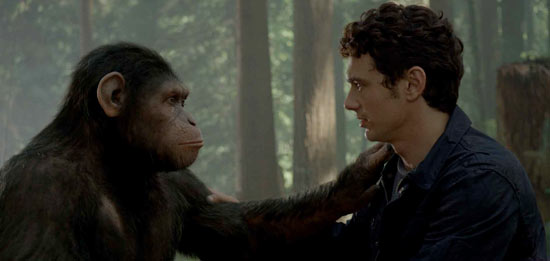
Andy Serkis as 'Caesar' in ROTPOTA.

First and foremost, the sole reason for anybody to waltz in to their local multiplex and watch this compelling tale of compassion, loss and liberation is Andy Serkis. What he has managed to achieve with Caesar is simply astounding. To display all of the vulnerabilities, sensibilities and, ultimately, strength emanating from this resolute primate is a staggering piece of work. By wrapping this ape's characteristics with humanity and warmth, Serkis has certainly left the Academy with no reason not to award him with a long overdue Oscar nomination. The 'stone age' film organisation has argued that his previous portrayal of Golem - and later King Kong - did not warrant the same level of merit in comparison to on-screen actors simply due to the misunderstood computer-generated veneer which was laid over his real actions. However, this is a sticking point with which the Academy is being criticised for by Serkis' on-screen brethren, as well as Serkis himself and rightly so. The ape-actor has recently been quoted as saying:

"It's frustrating that the process isn't better understood. It's easy to understand John Hurt's role in The Elephant Man, for which he won an Oscar [nomination]. He had layers of incredible make-up but the underlying performance won him an Oscar [nomination]. Performance-capture is the same as that but the make-up is applied as pixels painted on to the actor later down the line. Any actor should be able to play this kind of role, it's just a case of embracing the technology."

This technology is, quite simply, one future facet of the film industry. If Hollywood studio executives spent more time understanding and promoting the use of motion capture in film rather than over-saturating the market with cheap 3D technology, more production teams might be able to access the stellar tech put together by Weta Digital. In relation to ROTPOTA it is testament to Weta's work that you honestly forget the creatures on screen aren't real apes. This realism lends itself well to the story's narrative arc and helps root the series in a basis, which doesn't feel contrived or in any way 'far-fetched'. In fact, certain elements of the ape series (i.e. the apes' ability to communicate), which are explained in this prequel come across as shocking rather than predictable or expectant. This is simply due to the level of realism achieved using motion capture.

The ape-ape interaction drives the story forward in ways which could not be possible or feasible even a decade ago. During the ape sanctuary segment of the film, we witness how politics plays an integral role in these apes lives, as well as how Caesar rises from a pampered outsider to an unlikely champion and alpha-male amongst his fellow kind. This, all without speech. It truly is compelling viewing.

If there were any weak points to be identified - and there certainly are - one could deduce that the on-screen actors are up-staged by the apes. Only John Lithgow, as the traumatised Alzheimer's sufferer, and James Franco's doctor bring any sort of third dimension to the fore. Somewhat ironically this is mainly due to their interaction with Caesar. Of particular note is the formers emotional bond with the hyper-intelligent primate and his eventual acceptance that his disease will never leave him. I found it somewhat unusual that such emotional resonances would emerge from a summer blockbuster without feeling in any way 'cringe-worthy' or superficial.

However, it would appear the human-human interaction in Apes is one which is cast by the wayside. This is especially relevant to the relationship between Franco and Freida Pinto, who seems to play an all-together brighter version of 'Latika' from Slumdog Millionaire. Brian Cox plays the one-dimensional ape sanctuary manager; along with Tom Felton who personifies an even-more repulsive version of Draco Malfoy. One could argue that malicious keepers of their persuasion need only display aggression and distain, but it's seems a shame their motivations for this cruelty towards apes was in no way explored.


Can anyone spot the ever-so subtle nod to the original 1968 film within this image??

Given the well-orchestrated pace of ROTPOTA, the criticisms outlined previously may actually be irrelevant. Wyatt's direction is energetic and refreshing; blending the archetypes of a classic Spielbergian blockbuster with the tropes of a modern and ever-changing industrial beast. The infant director clearly has a deeply-held love for San Francisco and captures the allure and towering majesty of the Muir woods Redwood forest. I honestly had a moment of deja vu in watching those scenes, with Wyatt perfectly capturing the magic of visiting such a place.

Being such a fan of the original saga and an ardent hater of Tim Burton's dire re-imagining, I was somewhat, if not fully, sceptical that this prequel would be banished to the fiery pit of failure. Rise of the Planet of the Apes has, however, surpassed my lowly expectations in leaps and bounds. In this era of reboots and remakes, I find it deeply refreshing that a film has managed to pass through to the pantheon of rollicking entertainment with good intentions. It just seems a shame that the plethora of crap on offer at the cinema this year, although made with honest intentions, falls flat into the perpetual pits of Hades; with those lowly chimps, however, cackling from way up high.

Monday, 20 June 2011

Censorship, Centipedes & Classification


"Nothing is more dangerous than an idea when it is the only one you have." [Quote by Emile Chartier]

"Excessive violence", "scenes of extreme gore", "contains strong sexual violence" and "excessive use of strong language". These are consumer advice phrases, which typically land themselves on the reverse of a DVD case and which are becoming evermore frequent in the home entertainment market. As consumers who have arguably, in recent years, become desensitised to much of the violence and debauchery thrust upon us at cinemas, we tend to take these hollow and removed messages with little notice or regard. However, that does not detract from their main purpose and the guidelines laid out by the British Board of Film Classification (BBFC). These ratings are put in place so we, as the consumer, are able to assess for ourselves the suitability of such films for our person and the people around us. It gives generic reassurances to certain demographics that what they are about to watch can be understood and is suitable for a specific age group, with anyone of age below that certificate running the risk of being emotionally hurt as a result of viewing the film. 

However, it is not the primary role of the BBFC to censor films. Their job is to ensure these films are of a particular suitability and can be placed within a context, which an audience can understand and, therefore, not be grossly offended by.

With this in mind a certain news story, which has certainly piqued the interest of the national press in the past few days, has brought to light certain issues, which the film industry needs to address..... Now.

The Human Centipede: Part II (Full Sequence) has this week been denied certification and thus cannot be distributed in the United Kingdom. A BBFC spokesperson has remarked that the film is "sexually violent" and "poses a real, as opposed to a fanciful, risk that harm is likely to be caused to viewers." Furthermore, the statement gives a detailed description of the film and specific scenes, which are likely to cause an extreme level of offense. If you feel that this may be applicable to you, I suggest you skip the next paragraph.

According to the film board Centipede II focuses on the story of how one man becomes obsessed with a DVD copy of the original film and gains perverse pleasure in witnessing the barbarity of how the original victims suffered. The protagonist gains sexual gratification by masturbating under extremely violent circumstances, including wrapping "sandpaper around his penis".  In order to quench his disturbed desires, the mentally depraved individual endeavours to create his very own human centipede, forcing them to defecate into each others mouths, at which point he decides to rape one of the victims using barbed wire around his penis. The BBFC acknowledges that there has been no attempt to portray the victims as anything other than "objects to be brutalised, degraded and mutilated."

In some perverse way, the above description does not do the BBFC's statement justice. To read the full press release I suggest you head on over to http://www.empireonline.com/news/story.asp?NID=31162. Although, there has been quite a furore over this ban, I must say I do agree with the BBFC's decision for a number of reasons.

Censorship. It's a word which has been bandied about quite a lot in relation to this development and its inclusion in arguments is completely unfounded. As I've mentioned previously, it is not the BBFC's primary role to censor and ban films from being distributed. It is their responsibility to ensure that those spheres of society who may be vulnerable to such imagery are protected and I am not referring to those who are over the age of eighteen.

Although these films come with an age rating, it is inevitable that children under the age of eighteen will gain access to such material; be it through their parents purchasing a DVD from a store or a friend bringing round a video owned by an older sibling. I remember my older cousin bringing round horror films for us all to watch at the tender age of ten. For example, I had witnessed A Nightmare of Elm Street at the age of eight and other studies of the macabre before I had even arrived at the nightmarish leviathan known as High School. These films, viewed at that age, were truly terrifying and had a long-lasting effect.

Saying this, even through the myriad of violence and terror on the screen, I could recognise and relate to themes, which permeated through these horror masterpieces: Halloween dealt with the premise of constantly being watched by an unknown force, A Nightmare on the Elm Street explored the realms of the imagination and The Texas Chainsaw Massacre divulged the details of a twisted and disturbing family unit. The reason why these films are classics is not just due to their ability to strike fear in people, but also due to their exploration of recognisable themes, which have an effect on us all. This is one of the reasons The Human Centipede: Part II could be so volatile within the home entertainment sector and not the cinema.


The violence, gore and scares may not be suitable for the younger generations but films such as "Nightmare on Elm Street" explore territory, which children can be intelligent enough to recognise and comprehend.

Sexual perversion and gratification through violence and sadism are themes which still remain taboo within the film industry. Although, there are those who have managed to release their films by tackling these issues with some form of tact. Secretary, 8mm, The Cell and the HBO series True Blood to name but a few. What separates these films, however, from The Human pile of Centi-crap is their implicit, yet no less, barbaric nature. 

For instance, take the underrated 2007 horror Vacancy  starring Luke Wilson. Without giving away the whole plot, this film is set against the backdrop of the production of amateur snuff porn (An extremely sensitive issue). Due to the way in which Vacancy is filmed, we do not explicitly witness any "snuff porn", whereby some minor cast members pop their clogs (Although, it is certainly implied off-camera through the intelligent use of sound). As an adult, our imaginations are only limited by what we have experienced or been exposed to. Given this, we know in our mind's eye what has happened to these unfortunates in detail and are subsequently terrified by it. If a child of ten were to witness this same film, taking into account the limit of their imagination and their life experiences, they could only conclude that something "bad" has happened. 

This may sound quite an alarmingly deluded assessment, but when placed next to a film such as The Human Centipede it isn't hard to deduce why the BBFC have banned it from being classified. I am in no way saying that a child should watch Vacancy, or any other film similar to it, but I'm just stating that there is a certain level of security, which simply isn't present in Mr. Six's new film. Taking into account what the board have said about the matter, it may well be the equivalent of watching an explicit snuff porn film, regardless of whether this "piece of art" is fictional or  not.


Pitching this idea to the British Medical Council wasn't going to be easy.....

So why else do I agree with the council? Well to put it simply, the cinema world doesn't need Tom Six. With his first feature, the Dutchman proved with a sick idea, a good horror film do not make. It was hammy, inadvertently funny, poorly acted, scripted with the intelligence of a dead donkey and, in places, downright disturbing. The scares were as dull as a British politician's fashion sense and the only suspense was provided by wondering whether I had enough milk for a cup of tea after this display of utter crap had ended. To even ask why the first film was financed by a studio, yet alone distributed across America, is a question, which may well never be answered. From the outset and at its core, this film represents the imagination of someone who revels in violence, torture, perversion and sadism..... I will not for one more second burn off any more calories typing about this utter trash and that's that.

By reading the BBFC's statement it appears the second has completely discarded the "themes" of the first feature, with Six's only aim being to shock the living hell out of people and make it as horrific as possible. Six himself has questioned the Council's statement by stating his work is a "piece of art". All I have to say to this is what deluded corner of his brain produced that gem? More importantly, not all horror films have to be horrific (from the definition "grossly offensive to decency or morality"). You only have to watch the new wave of Spanish horror films, such as Julia's Eyes and The Orphanage, to appreciate that the horror genre can scare you but equally have a piece of superb storytelling at it's core; which Sixs' films have neither of.

So, in closing, I undoubtedly agree with the BBFC's decision. Yes, I do accept that this film will probably leak onto the internet and be viewed illegally but at the end of the day the BBFC have acted to limit its access to those who may be perceived as being vulnerable: children. As for Six himself, I don't believe the phrase "any publicity is good publicity" applies. Even if the film is downloaded illegally in this country, he won't get any of the royalties, as will there be no source of income from the home entertainment sector. I would never wish for any bad situation to befall any person but I am somewhat relieved that Six's warped, distorted and downright malicious imagination will not see the light of day in the film industry. Let's just hope that he doesn't wish to pursue a career in medicine!


Tuesday, 31 May 2011

Assassins, Hammers & Monkeys: A Review of the Recent Releases

The cinema has seen some pretty heavy traffic in recent weeks with films such as Joe Wright's much-anticipated thriller Hanna to the Norse-inspired, Shakespearean superhero epic Thor gracing the silver screen. I've had the pleasure (or in some respects, the displeasure) of watching some cinematic treats from a diverse range of genres, with a close group of confidantes. On the whole, I would say we probably agree on all of the films' lasting impressions but now is a chance to put it all down in black and white.

So let me dive straight in with a horror chiller, which, supposedly, is "so scary [you will be] whimpering in sheer terror."That's right it's the claustrophobic haunted house scare-a-thon, Insidious.


Patrick Wilson with Darth Maul's lesser-known cousin breathing down his neck in 'Insidious.'

Taking its ques from paedophobic horror classics such as Poltergeist, Insidious is a film, which valiantly attempts to reignite people's desire for a good old fashioned haunted house thrill ride. Telling the story of a family who are seemingly within the clutches of a malevolent paranormal entity, Insidious trades in the cheap, grotesque shocks produced by the recent stream of torture-porn movies for some truly terrifying imagery and some moments of cheap terror.

The team behind Saw and Paranormal Activity have somewhat succeeded in attempting to create a pastiche, which pays tribute to a classic, bygone horror era. James Wan does well to develop a discomforting atmosphere within the film's opening act; with an intelligently-edited sequence involving a burglar alarm and the sound of a gentle breeze demanding a special mention. All of the trademarks left by horror staples are also abundant: Moving books and boxes, creaking floorboards and living shadows. However, these devices never get old as they prey on some of our most innate fears. Saying this, the horror aficionados among you may amount these moments to recycled parlour tricks but, on a functional level, they leave the desired affect.

As the veil is slowly lifted on what is causing these abnormal disturbances, audiences will be gripped, yet at the same time cowering behind their coats. You will be treated to some disturbing imagery, including the image above, which will still shock you senseless even if you feel you're prepared for it. This is what Insidious is all about, until the closing act: A functional, yet derivative, horror film, which revels in scaring you with surreal imagery and some effective, albeit superficial, "jump out of your seat" moments.

If it wasn't for the film's denouement (a sequence involving a parallel world), this would have been a decent haunted house movie. Instead, Wan decides to reveal these entities, who look like they've come straight from a budget TV B-movie. In doing this, the young director has completely betrayed the principles he laid out in Insidious' opening hour (i.e. The principle that the less you see, the more you leave to the imagination). So, Insidious certainly isn't the piece, which will set the horror genre alight but it serves more as a decent, Friday night scare-a-thon, with some inadvertent comedy moments towards the final credits.

RATING: 3/5


Some ghetto-youths attempting to save the planet in Joe Cornish's debut feature "Attack the Block".

Attack the Block seems to have caused quite a stir in recent months amongst the critical elite, for all the right reasons. Touted as the successor to Shaun of the Dead, Attack the Block tells the tale of a ragtag bunch of neighbourhood delinquents who are forced to defend their apartment block from an onslaught of vicious extra-terrestrial cookie monsters.

It is very difficult to separate this piece from Edgar Wright's "zomromcom" Shaun of the Dead on a technical level. Each film boasts excellent editing, along with a fantastic soundtrack and some well-constructed set pieces. To put it bluntly, however, this is where the similarities end. Unlike, its forebear, Attack the Block does not allow you to sympathise or empathise with the main characters. It saddens me to say this considering how each role is so well-rounded, with some truly scene-stealing performances on show. The sole reason for my lack of empathy for this bunch, is through their actions in the film's opening moments. So as not to spoil anything for those of you who wish to watch this, the protagonists only have themselves to blame for their predicament. This led to me not caring whether they perished or stood triumphant at journey's end.

So as only to exacerbate my apathy, the film isn't funny or scary enough to be labelled as a horror comedy. Aside from jokes centring on the group's desire to "play FIFA" and destroy "those gorilla, werewolf motherf*&!ers", the film never reaches the heights of Wright's aforementioned pastiche, Raimi's Evil Dead trilogy or the definitive horror comedy; Ghostbusters.

Given all of this, it's a self-assured opening feature for Cornish, which is only hampered by some polarising story developments and a script lacking in snap, crackle and pop.

RATING: 2.5/5


Saoirse Ronon in 'Hanna'

Many would have scoffed at the idea that a director, whose back catalogue only consists of period dramas, could breathe new life into the saturated action thriller. Well, it looks like those sceptics may be choking from their scoffing, as Joe Wright has produced one of the year's top thrillers with Hanna. Initially taking place in the sparcity of the Tundra, Hanna is the story of a young girl being trained in the arts of assassination by her demanding, yet loving, father. Going into anymore detail will simply spoil this small gem of a movie but, suffice to say, the plot is as sparse as the icy plains it's set in. Alas, however, this is not to the narrative's detriment. By lending precious little detail, Wright is in fact able to launch the story along at a breakneck speed, without getting bogged down in waffling exposition.

As usual Ronon (Hanna) is a pleasure to watch, demonstrating yet again that she could be Hollywood's new, young starlet. Notable performances are also produced by Eric Bana and Cate Blanchett, who effortlessly nails the cold and detached nature of a CIA operative.

More importantly though, asides from being labelled as an action thriller, Hanna is also a terrific coming-of-age story. One in which a teenage girl is trying to understand the world around her, whilst also experiencing some radical changes. This is why I rate this film so highly. It is a cold and efficient revenge thriller, which will surprise you in the way in which it also steals your heart. Fantastic filmmaking, with a review which hasn't done it justice.

RATING: 5/5


"If I had a hammer, I'd hammer in the morning!"

"I am Thor, God of Thunder!!!" You can understand the nature of Kenneth Branagh's Thor just by reading the previous sentence: It's big, bold, melodramatic and not exactly understated. So, just like you can interpret the sentiment of Thor from his mighty battle cry, I will likewise describe this film with few words: Best comic book film in years. Go and watch it now!!! (Preferably in 2D though)

RATING: 5/5


Zach Galifianakis, Bradley Cooper and Ed Helms in 2009's "The Hangover".......Sorry I mean 2011's "The Hangover Part II".

Ever heard the phrase 'to flog a dead horse'? Well, it saddens me to say this may apply to The Hangover Part II, if the horse were a high-concept comedic stallion. Todd Phillips is no stranger to directing some top-class comedies over the years including Old School and the underrated 2004 ode to 70's police dramas, Starsky & Hutch. With the advent of The Hangover in 2009, however, the veteran "frat-pack" director managed to enter through the golden gates to the comedic Pantheon. Taking the simple concept of a dysfunctional group of friends attempting to piece together the night before, 2009's box office smash managed to wrangle all of the humour, vulgarity and genuine sentimentality it could from its severely dehydrated pores. Add to this some genuinely hilarious performances in the form of the mildly retarded Alan and a panic-stricken dentist by the name of Stu and you had a recipe for comedy gold.

More importantly this film produced a lot of gold in the literal sense. In America, it was hailed as the highest-grossing R-rated movie of all time. So, somewhat inevitably, a sequel was put through the pipeline and what a forgettable sequel it is at that.

The Hangover Part II is simply a carbon copy of the original set in a much darker and harsher setting than it's predecessor: Bangkok. A lot of critics have suggested this is the film's main fault but what were they expecting? Given that The Hangover was such a high concept to begin with, it would have been extremely difficult for the filmmakers to change the original narrative structure without losing what made the first film so unique. Although, undoubtedly, this is the only way Phillips could have made a sequel (by not altering a frame), Part II lacks the vitality, energy and mildly-vulgar humour of Part I. Instead we are treated to The Hangover tuned up to 11 and it is to the story's detriment.

Alan is now played as being completely retarded, without showing any signs of his once subversive intelligence. It makes for one or two awkward moments, whereby instead of laughing at or with him, I simply pitied him as a person. Don't get me wrong, Galifianakis is still a scene stealer but his character has changed in such a way that he doesn't come across as the lovable and affable dunderhead from Part I. As for some of the other performances, Bradley Cooper's screen time consists of him now fully committed to the job of on-screen "eye candy"but Ed Helms' Stu has a few moments to shine in the waning light.

The Hangover Part II also suffers from a narrative, which is disjointed and, to some extent, withdrawn in the sense that although you may hear what the Wolfpack are saying, you probably won't care. You will only want to witness the next underwhelming sight-gag or Alan-ism.

Despite all of this, Part II  did force me to laugh until it hurt at times. It's just that as a whole it was a rather forgettable affair, which, no doubt, is the way we all feel after a heavy night on the liquor.

RATING: 2/5 

Wednesday, 18 May 2011

"And the Winner is": A Retrospective on my Favourite Films (PART DEUX)


Over the past couple of weeks, I've been attempting to form some sort of opinion on what my top five favourite films are and what they mean to me as an avid cinema fan. Given my background in science, movies such as Star Wars captured my imagination as a child and others, for instance Jurassic Park, taught me somewhat tenuously that human endeavour goes hand-in-hand with uncertainty.

However, my interests are not solely encapsulated by science fiction. The works of Guillermo Del Toro, Peter Jackson, Martin Scorcese, Brian De Palma, Francis Ford Coppola and Juan Antonio Bayona have influenced my cinematic tastes over the years. Currently, my love is for foreign independent filmmaking. For example, Juan Jose Campanella's El secreto de sus ojos (The Secrets in their Eyes) catapulted Argentinian filmmaking into the mainstream of the Hollywood elite; earning an Oscar in the process and, more importantly, a place in my perpetually high DVD cabinet.

A few years back, my main interest was in the "gangster" genre, with films such as Goodfellas and The Godfather Trilogy being movies, which I'm still truly in awe of.

Before the Scorcese honeymoon period, I loved the typical Hollywood blockbuster and longed to keep watching the archetypal eighties action heroes kill several thousand film extras and jump through fire to reach the final credits.

Evidently, my love for films has evolved over the twenty three years I've been here. Cultural interests such as theatre, music and art ebb and flow with age, knowledge and the company we keep. So, with this list I have attempted to formulate a top five, which reflects my main influences and displays those films, which held a great significance for me when I first viewed them. Some of you may not be happy with some of the omissions I've made but you have the chance to defend your favourite films by commenting on the post. At the end of the day, this is only my opinion and any one can prove me wrong. So, enough with the endless blabbing, let's start where we ended last time with the flailing fish that is number five.......

5. THE DEPARTED (2006)


"What did you just say about deforestation? That you agree with it???!!!" [Di Caprio subsequently slams industrialist's head into the bar]

Based upon a Japanese crime trilogy (Infernal Affairs), The Departed was viewed as Scorcese's escape from the wilderness. No matter how much people revere the work of Martin Scorcese ( I, myself, are included in that overwhelming majority), he had not had a cast-iron hit since Cape Fear (1991). Yes, Casino was visually striking and yes, Gangs of New York had some incredible performances but none of his works post-1991 were tight. The aforementioned "hits" were overwrought, they lasted an insurmountable amount of time and were.....Well, boring.

With The Departed we were treated to a fantastic script, stellar performances, a story full of complexity and a musical score, which set those pulses racing. More importantly, this film moved with a pace not seen since Goodfellas. 

However, I am fed up of people comparing these two films when they are in fact completely different. Goodfellas, for all its visceral violence and extensive drug abuse, is a darkly romanticised vision of the Italian Mafia's inner workings, with a simplistic tale of three friends at its core. The Departed, on the other hand, is a much more realistic interpretation of the Boston underworld and demonstrates no matter what side of the law you are on there is no glory. Tie this in with the themes of loyalty, identity, law, justice and betrayal and you have a film, which embodies all of the traits which Scorcese has made his own. This is why I love The Departed. It captures the essence of Scorcese's earlier works, whilst also feeling fresh and original. Quite simply if you haven't watched this film, you need to!

4. FIGHT CLUB (1999)


"Fuck off with your sofa units and string green stripe patterns, I say never be complete, I say stop being perfect, I say let... lets evolve, let the chips fall where they may. " (Quote from Tyler Durden in David Fincher's 'Fight Club')


A gritty vision of consumer disillusionment, Fight Club represents an ideology, which has probably crossed the mind of many a white collar office worker. In an attempt to rid himself of all forms of social commodity and wealth, Edward Norton's nameless protagonist seeks therapy through the medium of violence and vandalism. Aided by a subversive soap salesman known as Tyler Durden (Brad Pitt), the two unhinged souls quickly embark on a journey of self-destruction with zealous abandon.

Weaving topics ranging from consumerism to nihilism into its intricately twisted plot, Fight Club can be credited as a film, which does not give a damn whether it offends, educates or inspires. As the viewer you take what you want from it. You can find perverse pleasure in the unflinching violence, soak yourself in the film's rich subtext, learn about schizophrenia or simply gain an understanding of how to make a bar of soap. That's the simple reason why this film is in my top ten: It works on a multitude of levels.

David Fincher has always been regarded as one of the cutting-edge directors of his generation, producing some fine works over the past fifteen years. However, even if you believe Seven was bordering on the darker shade of black, Fight Club is certainly his darkest and most mature piece. The production design, ranging from the dilapidated house on Paper Street to the oppressive grey monotones of Norton's workplace, never failed in displaying the grim banality that is our lives. This was achieved to the extent that you'd want to beat yourself up about how routine and prosaic modern Western society has become (potential spoiler!).

Back the production up with two career-defining performances along with a script, which will offend and delight in equal measure, and you are left with one of the greatest films of the past twenty years. So just remember the first rule of Fight Club: Bloody well talk about it and make sure everyone around you has watched it!

3. BACK TO THE FUTURE (TRILOGY: 1985 - 1990)


Michael. J. Fox as 'Marty McFly' and Christopher Lloyd as 'Doctor. Emmett Brown' in the "Back to the Future" series.

I toyed with the idea for a few weeks as to whether I should include all three of the most revered film trilogies in blockbuster history on my list: Star Wars, Indiana Jones and Back to the Future. However, I felt it only fair that one should reign supreme over all others. My instincts tell me that the Lucas followers amongst you will be raging and believing that Obi Wan has performed some sort of Jedi mind trick on my intellect. Not so I'm afraid. 

The simple explanation for my reasoning is down to the "two out of three ain't bad" rule. Irrespective of my frightening obsession with the two Lucas trilogies, I can't ignore the blatant fact that at least one film from each saga is sub-par (i.e. Return of the Jedi and The Temple of Doom). The former suggested that the formidable Empire could be dissolved by a group of teddies and the latter strayed away from a recognisable enemy, placing the audience outside of their comfort zone. Both films' problems were only exacerbated by some terrible continuity errors and lazy, by-the-by dialogue. Some of you may feel I'm being harsh and you would have a point if it wasn't for the originality and completeness of Robert Zemeckis' time-bending tale of a mad scientist and an average-joe teenager.

It would take a darkened soul to find any flaws in this fantastic comedy, which includes themes ranging from mortality, love, music, time travel and, most of all, uncertainty. The strength of this trilogy lies in it's ability to juggle a number of topics with such a breezy nature that you forget they are three separate films.

Zemeckis should also be credited for his sheer audacity and bravery in making Back to the Future. To include time periods ranging from the Old West to a stylised future vision of Hill Valley was a bold move, which could have easily isolated each film as three tenuously linked time-travel farces. However, by including Marty's perpetual struggle to set things right and allowing recognisable settings from Hill Valley to flow from one adventure to the next, we are able to identify and relate to each different setting. It's this marvellous continuity and evolution, which I greatly admire.

Along with the thematic context of Back to the Future are two performances, which were probably the best Hollywood produced in the 1980s. Christopher Lloyd flourished as the mad scientist who never failed in generating head-scratching paradoxes and Michael. J. Fox put himself on the movie map by playing the panic-stricken Marty McFly. It's saddening that we never got to see more of Fox on the silver screen due to his ongoing battle with Parkinson's disease, but he has given us one of the most memorable characters in film history.

A truly fantastic trilogy that will remain forever timeless.

2. AMERICAN HISTORY X (1998)


"Let us all hope that the dark clouds of racial prejudice will soon pass away, and that in some not too distant tomorrow the radiant stars of love and brotherhood will shine over our great nation with all their scintillating beauty." (Martin Luther King, Jr.)

For all the Governments the world over who would proclaim with the highest conviction that Martin Luther King need fear no more are, to some extent, delusional. Race and racism are still two subjects, which are as prevalent now as they were during the social upheaval of the 1960s. You only need look at recent events such as the LA riots to witness just how much racism is deeply engrained within society. They're also two subjects within the world of cinema which still remain, to some degree, taboo.

It wasn't until the release of American History X in 1998 that the themes of racial subversion, crime, poverty and education were all brought together to provide a crystal clear picture of how racism can develop within a conservative community. I mentioned in my last blog that Misery was probably one of the most frightening films ever made. In retrospect, I believe that Norton's decent into the dark underbelly of racist violence is the most frightening character development ever committed to film. 

Ironically, it wasn't the racism that shocked audiences but their own ability to empathise with the main character. Initially, Derek Vineyard (Norton) is a mild-mannered, middle-class American who is intelligent, charismatic and educated. However, following the death of his father, who was murdered at the hands of a black man, he is consumed with grief and is tempted by the provocative preachings of the local white power movement. To reveal any more of this frightening tale will no doubt spoil the experience for those who wish to watch this masterpiece.

To say this is a cathartic experience for the viewer, as well as for the characters within American History X, may seem to be extreme but there should be no underestimating the sheer power of this film. This is raw cinema, which is unrestrained in its ability to show that no matter who we are, we may all venture down the road best forgotten.


1. BLADE RUNNER: The Final Cut (Original Theatrical Release: 1982, Final Cut: 2007)


"I've seen things you people wouldn't believe..... [Now] all those moments will be lost in time, like tears in the rain. Time to die." (Batty from 'Blade Runner')

So here we are, at last arriving at what I believe to be one of the greatest films in cinematic history: Ridley Scott's Blade Runner. Fusing science-fiction with elements of film noire, this movie is undoubtedly the towering zenith of the Brit director's career. You could also argue this is one of the turning points in modern cinema, which helped to influence countless films and generate a whole new outlook on what can be achieved through sheer imagination. Interestingly though, if you were to ask the casual film-viewer what Ridley Scott has created over the past thirty years, you'd probably get a completely different answer to 'Blade Runner'.

I suppose a number of you will characterise Scott by his recent work on historical epics, such as Gladiator and Robin Hood. In their own right these are motion pictures, which are fondly remembered but can never be labelled as a defining point in the Brit director's illustrious career. To some extent, you may argue Alien marked the moment when Scott rejuvenated science-fiction and kick started a revolution in contemporary filmmaking. Although, this particular sci-fi horror is one of the greatest of its kind, it has not rippled through the cinematic pond in the same way Blade Runner has over the past thirty years.

It is funny that I am talking about a film in this way when it was in fact universally panned by critics on its theatrical release. Many believed it was convoluted, self-indulgent and lacking in any sense of coherency. These criticisms were only justified when it was discovered how many problems occurred during the film's development. The production was a costly nightmare, which resulted in a screenwriter leaving the studio and several investors cancelling their funding prior to principal photography. The actors, including Harrison Ford, were not happy with the endless rewrites and Scott was such an arse to work with that many crew members wore protest T-shirts proclaiming: "Yes Guv'nor, my ass!"

Many believed Blade Runner to be a mish-mash of ideas dreamt up by a director who only naively understood the themes and narrative of Philip. K. Dick's lauded novel, Do Androids Dream of Electric Sheep? Despite all of this, and after several cuts gracing the cinema screen over the past thirty years, I love this movie. More importantly, I adore Ridley Scott's intended vision of a near future Los Angeles. From his Final Cut we are able to lose ourselves in this world which thrives with life but is inhabited by those who do not understand the value of it. 

Unlike the other films on my list, I will not in any way describe to you the nature or narrative arc of this work of art. My reasoning for this is because I would like those of you who have not experienced it to view it as I did; with no inkling as to the sheer scope of Scott's vision or the fantastic narrative structure conceived by the late Philip. K. Dick. That way you will be able to interpret all of Blade Runner's ambiguities and nuances any way you see fit. Similar to any piece of art, with multiple viewings and the passage of time, Blade Runner's message will constantly glisten and transform with a clarity that only tears in the rain can display.

So, there it is laid out in black and white: My top five favourite films. I must admit it has been rather difficult over the past month to confine my cinematic preferences to ten slots but I hope you have enjoyed my final selection. I implore you to comment on the blog post if you vehemently disagree with my views or would simply like to put forward some of your own favourite pieces of cinema. 

Make sure you log onto the blog next week to read my short bumper review on all of the recent releases including: Thor, Insidious, Attack the Block and Hanna.

Saturday, 30 April 2011

"And the Winner is": A Retrospective on my Favourite Films (PART ONE)

With a pungent air of inevitability it would seem I have come to the stage where it is time to reveal my top ten favourite films of all time. People have been inquiring somewhat feverishly over the past few months as to what it is I feel defines a classic film. Other probing questions have ranged from "why in God's name do you think Empire is better than A New Hope??!!!" and "why do you have a disturbing obsession with all things relating to Martin Scorcese?" Well, hopefully this list will shed some light on my cinematic tastes and put to rest where I feel Jurassic Park lands amongst my convulted myriad of cherished movies....if at all! So, without further ado lets start at the trailing tortoise that is number ten......

10. SAVING PRIVATE RYAN (1998)


Tom Sizemore and Tom Hanks in the famous opening sequence of Saving Private Ryan

The morning of June 6th 1944 is a date etched into the minds of many as a day when thousands lost their lives in order to preserve peace and expel tyranny. Many films have attempted to capture the perils, which those brave men faced off the Normandy coastline, but none have done it so vividly as Steven Spielberg's WWII epic Saving Private Ryan. The first twenty minutes, which depict the landing on Omaha beach are brutal, barbaric, moving and, to some extent, claustrophobic. It's this one sequence which defines this war drama and is arguably one of the greatest battle scenes ever portrayed in modern cinema. Following this up with a terrific story and some truly magnificent performances, Saving Private Ryan will always remain to be a story which constantly reminds us that peace was only achieved with the sacrifice those men made on that long stretch of French coastline.

9. MISERY (1990)


Kathy Bates and James Caan in Rob Reiner's Misery

Based on the Stephen King novel of the same name, Misery tells the tale of writer Paul Sheldon. Deciding to finish his successful series of books on the escapades of 'Misery Chastain', Sheldon travels to New York to hand in his manuscript. Unfortunately for him, his car barrel rolls off the road during a snow storm and he sustains some nasty injuries. Fortunately though a nurse finds him near her lodge, deciding to bring Sheldon back and nurse him back to health............ Or so he thinks! It transpires that nurse Annie is his "no.1 fan" and demands that Sheldon writes a new book, which doesn't kill off his prized character.

Kathy Bates was awarded an Oscar for this performance and it is not very difficult to see why. Demonstrating the severe symptoms of a paranoid schizophrenic, Bates puts in a truly terrifying turn as Annie Wilkes. The sense of desperation and hopelessness that is prevalent throughout the film from Sheldon's POV is suffocating and we too live in Annie's prison for the two hour duration. Probably the best Stephen King adaptation to be committed to film (yes thats right, better than the much revered Shawshank Redemption). I implore you to watch this film by any means necessary as you will not be able to tear your eyes away from it.... Probably one of the most frightening films ever made.

8. WALTZ WITH BASHIR (2008)


Ari Folman in the animated feature Waltz with Bashir

Related to events surrounding the Sabra and Shatila massacres during the Lebanon war, Waltz with Bashir is a touching portrait of a man on a journey to find himself and determine his role in the genocide of thousands of Palestinians. Directed, written by and starring Ari Folman the film uses surreal animation to demonstrate the hallucinogenic effects of post traumatic stress disorder and delves into the hopelessness and contradictory nature of war. The film also seeks to educate those who are not familiar with the conflict in the Middle East and the importance of learning from such events. Backed up by a magnificent soundtrack Waltz is a touching and heartfelt personal journey into the heart of war and demonstrates that no matter how lightly the pebble hits the water, everyone can feel the waves.

7. JURASSIC PARK (1993)

Jurassic Park

Joseph Mazzello in "that scary kitchen scene with those velociraptors."

The second Spielberg film to make my list (Big sigh of relief from Stephen Cockerell): Jurassic Park, released long ago in 1993, redefined the modern-day blockbuster. Mixing shaky scientific principles, incredible animatronics, top-notch performances and a riveting soundtrack, JP is one of the reasons I fell in love with films. It was big, bold, brash and it scared the living crap out of me at the tender age of six. Based on the book by science fiction writer Michael Crichton, Spielberg's fully realised vision of a genetics experiment gone fatally wrong gripped you between it's jaws and tossed you about in a similar fashion to the fate experienced by the Ingen lackey after his infamous toilet stop.

It is testament to the work put in by Stan Winston (animatronics specialist on set) that this film still blows you away today. I remember watching it last year, for the one hundredth time, thinking to myself "why is it that no blockbuster film has come near this since?" The answer is simple: CGI..... Although the technology has its advantages, too many producers decide to put together a cheap package which manages to bring your disbelief crashing back down to Earth. I find it tragic that children born over the next few decades will never get to experience a film in cinemas of JP's magnitude and scope. To bring the point home I'll leave you with a quote from the blockbuster generator himself, George Lucas, commenting on the animatronics and small level of CG the film employed: "It was like one of those moments in history, like the invention of the light bulb or the first telephone call. A major gap had been crossed, and things were never going to be the same."Here, here Lucas!!

6. A SCANNER DARKLY (2006)


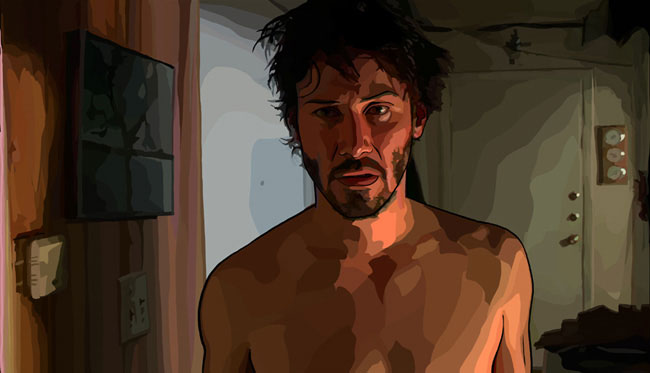
Keanu Reeves looking perplexed as to why this is the only film in which he acts proficiently.  

The first film on my list to be taken from a Philip. K. Dick short story, A Scanner Darkly is a rotoscoped film telling the tale of a group of friends hooked on a designer drug known as 'substance D'. Paranoid that they're being watched and believing the Government is intent on destroying their lives, their interpersonal relationships begin to unravel. Added to this atmosphere is the problem that Reeves' protagonist leads a double life and is addicted to the very drug he is attempting to eradicate. 

The small scale drama of this film is riveting and the animation is incredible. This is what makes the film so unique. Rather than adopting a full-scale animation approach, Richard Linklater decided to layer animation over the live footage he filmed. It gives the movie a very airy and surreal quality, leading you to almost question whether you're addicted to the drug yourself. Tie this in with some completely oddball personalities such as Robert Downey Jr, Woody Harrelson and a reformed Winona Ryder and you have a film which faithfully recreates the world Dick envisaged. Fantastic filmmaking and one which should most definitely not be missed.


Okay guys, there is part one of my top ten film list.... Log on to the blog site next week to find out my top five favourite films since the birth of time.


Sunday, 24 April 2011

Screaming, Slashing & Social Networking: A Review of Scream 4


"All of us have our individual curses, something that we are uncomfortable with and something that we have to deal with, like me making horror films, perhaps." (Quote by Wes Craven, director of the 'Scream' series)

If there was one facet of the horror genre, which was bemoaned by many critics and fans in the early nineties it was the tiresome bombardment of 'slasher' films from the previous decade. Ever since Carpenter's suburban nightmare Halloween, studio producers were foaming at the mouth, ready to cash in on this frighteningly exciting new sub-genre. Inevitably, sequels and pale imitations followed with horror aficionados being bludgeoned to death over the passing years with franchises hitting double figures. Friday the 13th alone now has eleven sequels and The Nightmare on Elm Street saga has generated a nightmarish eight. The trend even makes the recent Saw series seem like a miniscule blood splatter on horror's twisted canvas. 

Subsequently, cinema-goers were able to spot glaring cliches and caricatures after numerous Freddie Kruger or Jason Voorhees iterations..... Groups of pretentious teenagers would firstly go on a holiday or live in a neighbourhood, which coincidentally harboured a serial killer who had an ardent fetish for murdering affected youths. This ragtag bunch would also contain every single polarising stereotype present within the high school education system: The "jock", the "bimbo", the "black dude", the "geek", the "average joe" and the "introverted yet unbelievably resolute and strong" heroine. Said group of realistic interpretations of the average American teenager would be hunted down one by one and brutally murdered in all manner of grisly fashions. In attempting to escape from their impending doom, said teenagers would take every illogical step necessary to ensure they would meet thy maker. Some interesting examples include going up an ominous staircase, getting lost in the woods, forgetting to charge their phone battery, having no change for a payphone or staying in their homes alone (safe in the knowledge that no one could ever break through the leaded windows or smash through the door with a very large murder weapon, e.g. a machete or axe etc....). Although, one fortunate soul was left by the end, only to get murdered in the inevitable sequel.

Ironically, it would take a man who had started this low-quality trend to reinvigorate the 'slasher' genre and give it a distinctive class not seen since Hitchcock's Psycho. Wes Craven's self-labelled meta-horror Scream opened in 1996, with both audiences and critics applauding Craven's twisted satirical take on an art form which had become stale, flabby and overwrought. The "Master of Horror" managed to tackle the cliches which slashers had become soaked in with humour and panache, whilst also providing audiences with incredible scares and a bucketload of gore. Not only did Craven tackle the aforementioned horror staples, he also managed to inject this new breed of slasher with something else: Unpredictability. In the same vein as Psycho before it, the closing act and reveal of the "ghostface" killer shocked audiences into paralysis, not only due to the person(s) behind the murders but also due to their deeply sadistic and disturbing motivations.

Scream followed the lives of a group of friends from Woodsboro High who are targeted by a relentless killer, with a penchant for horror movies. Through his malicious games the teenagers are lead into a number of old Hollywood adages, seemingly unaware that Ghostface is creating his very own "slasher" movie. It is testament to Craven and Williamson (who wrote the screenplay for Scream) that they had catapulted another icon into the forefront of horror cinema: Ghostface. A killer who spouted now famous lines such as "what's your favourite scary movie?" and "....I want to know what your insides look like." Craven was certainly influenced by some of his previous works, such as The Last House on the Left, in creating this Halloween-costume killer's defining characteristic. He was a normal, albeit mentally ill, person like you and me. With this knowledge, audiences realised that the killer was one of the victim's number. It was truly ground-breaking at the time. It's just a shame this film reignited the same period, which Craven sought to end: Endless imitations and sequels. By the time Scream 3 rolled around in the year 2000, it was evident that the franchise was quickly becoming it's own worst enemy.


So with the passing of another decade in the filming of the macabre, where is the industry now? Well, since the release of Scream 3 there have been a staggering seven Saw films, with each sequel managing to reach a new, inconceivable low. There have been two Paranormal Activity's, two Hostel films and two reincarnations of Leatherface from the The Texas Chainsaw Massacre (which, by the way, has completely destroyed the credibility of the original). Along with this myriad of crap, there have also been remakes of The Hills Have Eyes, Friday the 13th and The Last House on the Left. This has been the decade of "torture porn" and a black mark within the book of all things horror. These films are lacking in all forms of intelligence, with only the writer's thirst for senseless violence being satisfied. So, it seems fitting Craven and Williamson have decided to create a sequel to a beloved franchise, which seeks to criticise the evolution of horror over the past ten years.


I'm assuming this scene will not be ending with Courtney Cox and Ghostface rolling around in the hay.

Scream 4 sees the return of the principle characters from the original trilogy: Sydney (Neve Campbell), Gale (Courtney Cox) and Dewey (David Arquette). The story takes place on the fifteenth anniversary of the Woodsboro murders, with Sydney returning to the town to promote her self-help book "Out of the Darkness." Gale and Dewey are happily married; with the former struggling with writer's block and the latter now miraculously assigned to the role of Sheriff. Along with the aging Scream protagonists are a fresh batch of teenagers waiting to be sliced-n-diced, including Sydney's cousin (Emma Roberts) and "that cheerleader from Heroes" (Hayden Panettiere). Somewhat inevitably, two teenage girls are murdered in a typically barbaric fashion on the eve of the Woodsboro anniversary and so begins another tirade of film trivia laden phone calls and grotesque stabbings.

Although, Craven carries the plot along at a frenetic pace, the story arc for the helpless and hapless residents of Woodsboro is full of plot holes...... Very large and gaping plot holes. Firstly, why in God's name would Sydney think it wise to revisit her hometown on the anniversary of these savage murders? Why would a school still be open, given that the majority of its demographic have been slain at the hands of a mad man? Why would Dewey be head of a police force, which is probably more inept than the first recruits of Police Academy?

You can forgive Craven after one sequel for letting his characters "get on with their lives" but it is inexcusable to say these people wouldn't have learnt their lesson a decade after the first slaughter!.....Herein lies Scream 4's first problem: It has become a parody unto itself! Some would argue so much so that it feels like an annual pantomime. Williamson seems to have crafted a world, which is happy to make fun of itself rather than the world of horror and reboots in particular. I had faith in Craven to create a satire of the last ten years of horror. Instead, Williamson sums up the past decade with one line: "Saw 5 was shit." I've never actually witnessed such lazy and defeatist dialogue in a long time. Rather than satirise torture-porn or lampoon remakes, we're treated to a simple re-tread of a once revered franchise.


Erik Knudsen (left) fashioning the "latest" designer webcam gear........

However, Craven attempts to make a comment on the social upheaval of the past decade, demonstrating how the cult of celebrity and social networking sites such as Facebook have revolutionised and warped our sense of community. For the most part he succeeds but the technogeek sub-plot reeks of an ill-inspired afterthought and the youtube generation are treated to a weak plot thread revolving around the killer "filming his murders"...... None of which he actually posts on the internet!

Although, the majority of Scream 4's script is awful, parts of the film do pack a humorous punch, with the police officers debating who will die first a particular highlight. The film's opening is also incredible, managing to poke fun at the horror sequel culture, whilst also providing some genuine scares. However, these moments are few and far between, with the final act coming across as a Tom Stoppard farce.

This foray into inadvertent comedy is only compounded by some genuinely "cringe worthy" performances. Emma Roberts does her best to play the most mundane character ever to be portrayed in recent cinema. The only thing Hayden Panettiere does differently to her cheerleader incarnation from Heroes is to cut her hair and scream loudly. Rory Culkin's film buff lacks the charisma of the much loved Randy from the nineties trilogy and I simply don't remember the other faceless characters. However, Campbell, Cox and Arquette somehow manage to steer this creaking ship regardless of the terrible acting heaped upon it. Cox and Arquette in particular have some devilishly funny dialogue between them; the latter providing some razor sharp comedic flourishes.

Despite all of Scream 4's flaws I still managed to enjoy it. As a simple, no-brainer slasher film Craven and Williamson have undoubtedly succeeded. At face value it's a generic thrill ride but oh how it could have been so much more (pardon the cliche). I fell in love with this franchise because it was never afraid to comment on the state of horror and always provided subtle nods to long-forgotten chillers. However, as I said earlier Scream has most definitely become it's own worst enemy by evolving into the sort of film Craven sought to ridicule. So if Craven receives a phone call from Ghostface late one moonless night and is quizzed on his comprehension of modern horror he'd certainly be the first one to be "gutted like a fish."

Saturday, 2 April 2011

Trepidation and Contempt on the Outer Limits: A Review of Limitless


"Drugs are a bet with your mind." (Quote by Jim Morrison from the American rock band "The Doors")

It seems rather apt that I have decided to open this review with a famous quote made by one of the most controversial figures in 20th century music. Not solely due to the quote itself, which stands as a telling elucidation of the film's central theme, but also due to the attribution associated with the statement. "The Doors" was a name inspired by Aldous Huxley's book on his experiences with mescaline. Entitled The Doors of Perception, Huxley referred to a quotation by the eminent poet William Blake: "When the doors of perception are cleansed, things will appear to man as they truly are.... Infinite." Huxley acknowledged that any user could open their mind to a plethora of possibilities and would experience a vision of clarity not achievable in a normal state.

This is certainly one of the central themes of Neil Burger's stylised thriller Limitless. Starring Bradley Cooper, Robert De Niro and Abbie Cornish this study into the addiction of success, as well as conventional drug abuse, has seen an overwhelmingly positive response from US audiences and critics. Normally, when I see "US NO.1 BOX OFFICE SMASH HIT" emblazoned all over a film poster, I tend to distance myself from it like the similar poles of two gargantuan magnets. As I've mentioned in previous reviews box office success does not necessarily correspond to fresh, original and marvellous filmmaking. Quite the opposite in fact. Film studios tend to label their cash cows with "modest" platitudes solely to drive baffled herds of film-goers into cinemas just to witness utter garbage, thus lining their gold-plated coffers with piles of money. For instance take films such as Just Married, The Last Exorcism, American Pie Presents Band Camp, The American, Ocean's Twelve  and Battle: Los Angeles to name but a few. However, in this particular instance Limitless deserves all of the praise heaped upon it.

Based on the 2001 techno-novel by Alan Glynn entitled The Dark Fields, Limitless tells the story of a washed-up writer in New York City. Eddie Morra (Cooper) suffers from the worst case of writer's block since Jack Torrence in The Shining or, alternatively, acute laziness or self-pity. Dumped by his successful girlfriend (Cornish) and missing a  multitude of deadlines for his book, Morra seems to be a man on the precipice of ultimate failure. However, a chance meeting with his ex brother-in-law and their subsequent conversation gives Eddie the opportunity to try a new "FDA approved" drug known only as NZT-48, which gives the user the ability harness the full power of the brain. With no other avenue to pursue and in utter desperation Morra swallows the transparent tablet only to realise that he is now vastly more intelligent and able to focus to a degree not experienced by normal human beings. What follows is a dizzying ascension to the summit of success, as Eddie can learn to speak many languages fluently, utilise the power of mathematics to dabble on the stock market and use his heightened focus to finish his book in four days. Although the heights to which Eddies attains would be tempting for any of us to seek, Burger also demonstrates the powerful side effects of NZT, whilst also showing audiences that no matter how intelligent Eddie Morra is there will always be like-minded geniuses out there. The director also allows the audience to see that the desperation Eddie experienced before taking NZT, is only replaced by a more burning desperation to be more successful, whilst also frantically craving more of this new untested drug.

In terms of narrative, Burger has certainly nailed how one person would be tempted by and react to this new designer drug. Bradley Cooper provides a narration to fully immerse the audience and allows them to delve into the mind of this desperate, yet intelligent man. Normally, I don't approve of such a plot device as it spoon -feeds an audience rather than relying on any visual flair to tell a story. However, with Cooper's delivery we are able to soak ourselves in all of the idiosyncrasies of this character as well as watch the film in gut-wrenching tension, excitement, suspense, elation and disbelief. Burger also manages to produce an incredible atmosphere of paranoia as the side-effects begin to suffocate Morra. Through the clever use of narrative and camerawork in unison, we begin to question Morra's mental health and whether his perception of certain events is the correct one. Although, this is all well and good there was one plot hole, which I felt wasn't convincing enough to drive the story forward at one point. Throughout the course of the film, Eddie deals with some very undesirable characters. If he was supremely intelligent, why would he even contemplate dealing with such people? Maybe this was Burger's commentary on whether, regardless of intellect, we would still stoop low enough to satisfy our desire to succeed? I leave that for you to decide.


Bradley Cooper playing Eddie Morra (looking rather ill and paranoid) in 'Limitless'

This is a film whereby the ensemble cast are all brilliant. Cooper seems to have been written off in recent years as a "one-trick pony", with only the ability to play characters with 100% charisma and no substance whatsoever. Although, for a large part of this film, he does play a character who is cocky and arrogant, Cooper convinced me completely that this was a man on the edge, who was suffering from some severe side effects and an acute bout of paranoia. The initial plot development of Morra taking this drug from a man he hasn't seen in years could have been entirely implausible had it not been for Cooper's portrayal of a man in complete desperation.

The man himself, Robert De Niro, has finally landed in a film which isn't crap! For two hours, I had completely forgotten he'd recently starred in the mindless and juvenile drivel that was "Meet the Fockers."Although he didn't have much to do in this film, asides from give sound advice to Cooper's character, it was a solid performance. Surprisingly not mentioned as a title character, Anna Friel's brief appearance is a memorable one. Playing a former NZT addict, I found her performance haunting and deeply unsettling. By introducing her into the fold, it allows the theme of drug addiction to blossom even more as Morra hastily continues to "up his dosage" and not heed the words of his former lover. Put simply, a very clever character addition.

Although, the performances in Limitless are fantastic, the cinematography, editing and direction are where it truly shines. Cooper creates a vibrant and effervescent New York, which is reminiscent of a similar feat achieved by Michael Mann in Miami Vice or  Matthew Weiner in the TV show Mad Men. This quality is only heightened when Morra is on NZT. Upon taking the drug, the ambient light around him brightens, giving a greater sense of clarity and definition. It's a fantastic editing tool and is very similar to a technique used by Jonathan Demme in The Manchurian Candidate (2004), a film which I highly recommend. However, what nailed it for me personally was what I like to call the "lightspeed" shot. To simulate the passage of time and space, whilst also displaying the dizzying effects of taking such a powerful drug, Burger uses this particular shot. Imagine witnessing the "jump to lightspeed" shot from Star Wars, replacing the stars with buildings, whilst the camera is physically moving forward through the frame. If it sounds nauseating it certainly is but I assume that this is what Burger set out to achieve and it is, to put it lightly, bloody fantastic!

In closing, Burger has achieved something, which is not readily attainable in cinema: the depiction of the peaks and troughs of drug abuse. He allows us to appreciate that success, in of itself is a drug which everybody takes with unquestionable conviction and that the higher up the ladder you go, the only thing you're achieving is increasing the distance you will fall. For those of you who wish to go to see this fresh and original film I must insist that the doors of your own perception won't be cleansed, they'll be well and truly kicked down.

Monday, 14 March 2011

Nightmares and Necromorphs: A Review of Dead Space 2


"For what's it worth, you did a great job Issac...." (Kendra Daniels from 'Dead Space')


Survival horror seems to have had an identity crisis in recent years. Gamers have purged scores of the undead in the slums of Africa, fought hordes of blood-thirsty villagers in Eastern Europe and also fell asleep whilst playing Silent Hill: Homecoming.  The first two scenarios are from Capcom's 2009 hit Resident Evil 5 and Shinji Mikami's brainchild Resident Evil 4. RE4 was seen by many to reinvigorate a stagnating genre and open the blood-soaked floodgates to the masses. However, in my view it reinvigorated a franchise and not the survival horror genre as an entity. This could be attributed to the simple fact that Mikami transformed a once isolated and terrifying experience into a gung-ho and unsettling romp through murky villages and imposing churches. It may be an engaging experience but that doesn't detract from the argument that Capcom has now veered into "action horror" territory. To reinvigorate "survival horror" the industry desperately needed a developer who was willing to drag the genre back to its roots, even if RE4/5 aficionados would dig their fingers into the ground with abject futility.

2008 saw the arrival of a fearless engineer known as Isaac Clarke; with Visceral Games kick-starting a genre, which has been left to rot since the glory days of Konami and their much-revered IP Silent Hill. Dead Space told the story of Issac, whose team are sent by a shady organisation to ascertain why a "planet cracker" (the USG Ishimura) has ceased all contact. The extraction team land on the ship only to find that the inhabitants of the vessel have all met a grisly end. Needlessly to say, things do not go according to plan and Issac is left to fend off the deformed and infected shipmates. Clarke's story is a very personal one as he attempts to discover what happened to his girlfriend, who works on the doomed ship, and destroy the "marker", which controls the infected "necromorphs" with a vice-like grip.

The EA title managed to combine satisfying gunplay, unique puzzles, extreme scares and an escalating sense of dread to create an experience like no other on the current generation of consoles. Personally, the sense of dread and hopelessness was a highlight as I could feel fear for the first time since my first play-through of Silent Hill 2. Another aspect of the game, which morphed it into a true classic was its reverence to it's source material. The blood-smeared corridors, atmospheric lighting and excruciating isolation were reminiscent of sci-fi horror staples such as Alien and the severely underrated Event Horizon. However, it was never referential to the point of feeling contrived as so many other games these days seem to be made.

From the critical and financial success of Dead Space, it was inevitable EA would demand Visceral Games construct another scenario for Isaac to be subjected to. Dead Space 2 was released in the UK on January 28th 2011 and, after another ardent battle with the necromorph scourge, I've finally completed the game.

The story of DS2 takes place three years after the horrific events, which took place on the USG Ishimura. Our hero - Isaac Clarke - has awoken from a lengthy coma into a nightmare on the Titan metropolis of the "Sprawl." Necromorphs have transformed this once idyllic symbol of human endeavour into a decrepit and pulsating Valhalla. With no recollection as to how he came to be institutionalised in this terrifying Hell, Clarke frantically attempts to escape a nightmare he thought he had seen the last of. Isaac is also suffering from horrific hallucinations, with his mind slowly unravelling over the course of the twelve-hour adventure. In communication with other survivors, whilst hiding his condition from them, the intrepid engineer begins to understand that a "marker" has been built within the Sprawl and sets out to destroy it. Driven by guilt after the loss of his lover, whilst also being plagued by visions of her, Isaac seems to be a frightening shadow of his former self.

If there was one area in which I could identify a weakness it is most certainly the overarching story of the game. It has clearly been written in such as way as to drive the player from one epic set piece to another. Being one for engrossing narratives I would normally find this detrimental to my overall playing experience. However, the character development is carried out with such a high level of depth and sophistication, the "wild goose chase" storyline doesn't seem to matter. Unlike the first Dead Space, Visceral Games have given Isaac a voice. Many gaming critics were extremely sceptical upon hearing that this story mechanic would be integrated into the game. Their argument stemmed from the notion that by having a silent protagonist, the player can place "their own stamp" upon Isaac and fully immerse themselves in the character. However, by giving Isaac some dialogue I actually cared about what happened to him and feared for his mental wellbeing. This empathy was also enriched by Isaacs interactions with other characters. I feel these interactions heavily rely upon the presence Isaac's voice, as well as the amazing dialogue and voice acting on show.

In terms of gameplay, Visceral has clearly refined the combat mechanics to make for far more tactical confrontations with a diverse array of enemies. By swamping the player in waves of necromorphs, the "kinesis" and "stasis" tools become quintessential assets. In streamlining the controls, to suit for a more fast-paced play style, kinesis can be used in quick combination with Isaac's standard weapons to propel the necromorph's own severed limbs straight into their disfigured bodies. It certainly makes for some compelling, yet awfully grotesque encounters. The "zero-G" sections have also returned and do not feeling like lumbering or arduous affairs any more. This is due to the introduction of the Iron Man-like rocket boots, which Isaac now possesses, enabling the player to move with a greater degree of freedom and also opening up a wide field of view.


Seems this merry bunch are intending to give Isaac a hug........


Atmospherically and graphically, Dead Space 2 is both terrifying and breathtakingly beautiful respectively. The lighting and colour contrast is used to such powerful effect that Visceral has created a world which feels both realistic and strikingly vivid. LCD billboards bathe the screen in glorious colour, shadows stretch and twist with an unerring darkness and decaying tissue gleans with sickening scarlet. All of which combines to create an atmosphere to rival the higher echelons of cinematic horror, such as John Carpenter's The Thing and the aforementioned Event Horizon. Equally, the sound design also plays it's part in this science-fiction nightmare. Creaking machinery and the cries of unfortunate victims are blended together to fill the player with a disturbing sense of doubt in what they've just heard. In some instances, you'll be forced to root Isaac to the spot as you attempt to discern what is happening in the bowels of darkness engulfing the path ahead. The fear engulfs and suffocates you until all you can do is pause the game and breathe a sigh of relief that it's only just that: A game.

Adding to this sense of fear, is the unpredictability and sheer relentlessness of the enemy AI. Visceral have kept the same assortment of enemies from the original, whilst also including a few new additions. These chilling creatures include the "raptor," which cower behind corners and in the shadows before dashing towards you with incomprehensible speed. The horde-like mentality of the "children" sends you into a panic-stricken state as you fire off rounds with complete disregard, forgetting that ammunition is a scarce commodity on the Sprawl. You'd certainly be forgiven for breaking into a sweat during these encounters and may be a blubbering wreck by the time the epic and chilling ending rears its disfigured head. 

Dead Space 2 is a game which requires players to invest their emotions in an ensemble of characters, whose ongoing struggle to break free from this perpetual nightmare takes precedence over the somewhat "rehashed" storyline from the original. This approach of character development over plot development is strikingly similar to last years Christmas hit Assassin's Creed: Brotherhood. However, it never matters as you are completely and utterly swept up in this fear-mongering thrill ride. Mechanics, graphics and atmosphere all mesh to create an absorbing, yet utterly terrifying, game. Be warned, however, that once you enter the Sprawl it may not be Isaac Clarke's mental wellbeing you should really be concerned about.......

Dead Space 2 is now available on the Xbox 360, Playstation 3 and PC at all good retailers.