Saturday, 30 April 2011

"And the Winner is": A Retrospective on my Favourite Films (PART ONE)

With a pungent air of inevitability it would seem I have come to the stage where it is time to reveal my top ten favourite films of all time. People have been inquiring somewhat feverishly over the past few months as to what it is I feel defines a classic film. Other probing questions have ranged from "why in God's name do you think Empire is better than A New Hope??!!!" and "why do you have a disturbing obsession with all things relating to Martin Scorcese?" Well, hopefully this list will shed some light on my cinematic tastes and put to rest where I feel Jurassic Park lands amongst my convulted myriad of cherished movies....if at all! So, without further ado lets start at the trailing tortoise that is number ten......

10. SAVING PRIVATE RYAN (1998)


Tom Sizemore and Tom Hanks in the famous opening sequence of Saving Private Ryan

The morning of June 6th 1944 is a date etched into the minds of many as a day when thousands lost their lives in order to preserve peace and expel tyranny. Many films have attempted to capture the perils, which those brave men faced off the Normandy coastline, but none have done it so vividly as Steven Spielberg's WWII epic Saving Private Ryan. The first twenty minutes, which depict the landing on Omaha beach are brutal, barbaric, moving and, to some extent, claustrophobic. It's this one sequence which defines this war drama and is arguably one of the greatest battle scenes ever portrayed in modern cinema. Following this up with a terrific story and some truly magnificent performances, Saving Private Ryan will always remain to be a story which constantly reminds us that peace was only achieved with the sacrifice those men made on that long stretch of French coastline.

9. MISERY (1990)


Kathy Bates and James Caan in Rob Reiner's Misery

Based on the Stephen King novel of the same name, Misery tells the tale of writer Paul Sheldon. Deciding to finish his successful series of books on the escapades of 'Misery Chastain', Sheldon travels to New York to hand in his manuscript. Unfortunately for him, his car barrel rolls off the road during a snow storm and he sustains some nasty injuries. Fortunately though a nurse finds him near her lodge, deciding to bring Sheldon back and nurse him back to health............ Or so he thinks! It transpires that nurse Annie is his "no.1 fan" and demands that Sheldon writes a new book, which doesn't kill off his prized character.

Kathy Bates was awarded an Oscar for this performance and it is not very difficult to see why. Demonstrating the severe symptoms of a paranoid schizophrenic, Bates puts in a truly terrifying turn as Annie Wilkes. The sense of desperation and hopelessness that is prevalent throughout the film from Sheldon's POV is suffocating and we too live in Annie's prison for the two hour duration. Probably the best Stephen King adaptation to be committed to film (yes thats right, better than the much revered Shawshank Redemption). I implore you to watch this film by any means necessary as you will not be able to tear your eyes away from it.... Probably one of the most frightening films ever made.

8. WALTZ WITH BASHIR (2008)


Ari Folman in the animated feature Waltz with Bashir

Related to events surrounding the Sabra and Shatila massacres during the Lebanon war, Waltz with Bashir is a touching portrait of a man on a journey to find himself and determine his role in the genocide of thousands of Palestinians. Directed, written by and starring Ari Folman the film uses surreal animation to demonstrate the hallucinogenic effects of post traumatic stress disorder and delves into the hopelessness and contradictory nature of war. The film also seeks to educate those who are not familiar with the conflict in the Middle East and the importance of learning from such events. Backed up by a magnificent soundtrack Waltz is a touching and heartfelt personal journey into the heart of war and demonstrates that no matter how lightly the pebble hits the water, everyone can feel the waves.

7. JURASSIC PARK (1993)

Jurassic Park

Joseph Mazzello in "that scary kitchen scene with those velociraptors."

The second Spielberg film to make my list (Big sigh of relief from Stephen Cockerell): Jurassic Park, released long ago in 1993, redefined the modern-day blockbuster. Mixing shaky scientific principles, incredible animatronics, top-notch performances and a riveting soundtrack, JP is one of the reasons I fell in love with films. It was big, bold, brash and it scared the living crap out of me at the tender age of six. Based on the book by science fiction writer Michael Crichton, Spielberg's fully realised vision of a genetics experiment gone fatally wrong gripped you between it's jaws and tossed you about in a similar fashion to the fate experienced by the Ingen lackey after his infamous toilet stop.

It is testament to the work put in by Stan Winston (animatronics specialist on set) that this film still blows you away today. I remember watching it last year, for the one hundredth time, thinking to myself "why is it that no blockbuster film has come near this since?" The answer is simple: CGI..... Although the technology has its advantages, too many producers decide to put together a cheap package which manages to bring your disbelief crashing back down to Earth. I find it tragic that children born over the next few decades will never get to experience a film in cinemas of JP's magnitude and scope. To bring the point home I'll leave you with a quote from the blockbuster generator himself, George Lucas, commenting on the animatronics and small level of CG the film employed: "It was like one of those moments in history, like the invention of the light bulb or the first telephone call. A major gap had been crossed, and things were never going to be the same."Here, here Lucas!!

6. A SCANNER DARKLY (2006)
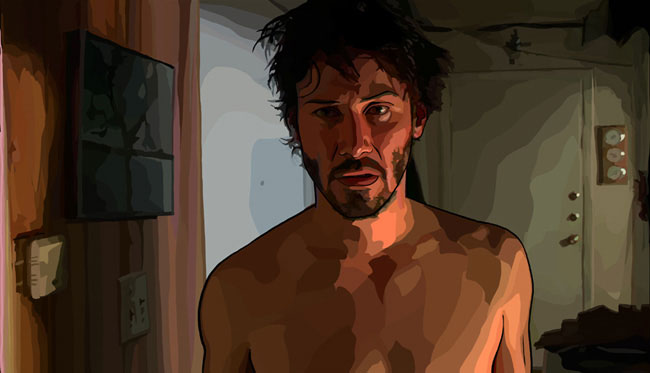

Keanu Reeves looking perplexed as to why this is the only film in which he acts proficiently.  

The first film on my list to be taken from a Philip. K. Dick short story, A Scanner Darkly is a rotoscoped film telling the tale of a group of friends hooked on a designer drug known as 'substance D'. Paranoid that they're being watched and believing the Government is intent on destroying their lives, their interpersonal relationships begin to unravel. Added to this atmosphere is the problem that Reeves' protagonist leads a double life and is addicted to the very drug he is attempting to eradicate. 

The small scale drama of this film is riveting and the animation is incredible. This is what makes the film so unique. Rather than adopting a full-scale animation approach, Richard Linklater decided to layer animation over the live footage he filmed. It gives the movie a very airy and surreal quality, leading you to almost question whether you're addicted to the drug yourself. Tie this in with some completely oddball personalities such as Robert Downey Jr, Woody Harrelson and a reformed Winona Ryder and you have a film which faithfully recreates the world Dick envisaged. Fantastic filmmaking and one which should most definitely not be missed.


Okay guys, there is part one of my top ten film list.... Log on to the blog site next week to find out my top five favourite films since the birth of time.


Sunday, 24 April 2011

Screaming, Slashing & Social Networking: A Review of Scream 4


"All of us have our individual curses, something that we are uncomfortable with and something that we have to deal with, like me making horror films, perhaps." (Quote by Wes Craven, director of the 'Scream' series)

If there was one facet of the horror genre, which was bemoaned by many critics and fans in the early nineties it was the tiresome bombardment of 'slasher' films from the previous decade. Ever since Carpenter's suburban nightmare Halloween, studio producers were foaming at the mouth, ready to cash in on this frighteningly exciting new sub-genre. Inevitably, sequels and pale imitations followed with horror aficionados being bludgeoned to death over the passing years with franchises hitting double figures. Friday the 13th alone now has eleven sequels and The Nightmare on Elm Street saga has generated a nightmarish eight. The trend even makes the recent Saw series seem like a miniscule blood splatter on horror's twisted canvas. 

Subsequently, cinema-goers were able to spot glaring cliches and caricatures after numerous Freddie Kruger or Jason Voorhees iterations..... Groups of pretentious teenagers would firstly go on a holiday or live in a neighbourhood, which coincidentally harboured a serial killer who had an ardent fetish for murdering affected youths. This ragtag bunch would also contain every single polarising stereotype present within the high school education system: The "jock", the "bimbo", the "black dude", the "geek", the "average joe" and the "introverted yet unbelievably resolute and strong" heroine. Said group of realistic interpretations of the average American teenager would be hunted down one by one and brutally murdered in all manner of grisly fashions. In attempting to escape from their impending doom, said teenagers would take every illogical step necessary to ensure they would meet thy maker. Some interesting examples include going up an ominous staircase, getting lost in the woods, forgetting to charge their phone battery, having no change for a payphone or staying in their homes alone (safe in the knowledge that no one could ever break through the leaded windows or smash through the door with a very large murder weapon, e.g. a machete or axe etc....). Although, one fortunate soul was left by the end, only to get murdered in the inevitable sequel.

Ironically, it would take a man who had started this low-quality trend to reinvigorate the 'slasher' genre and give it a distinctive class not seen since Hitchcock's Psycho. Wes Craven's self-labelled meta-horror Scream opened in 1996, with both audiences and critics applauding Craven's twisted satirical take on an art form which had become stale, flabby and overwrought. The "Master of Horror" managed to tackle the cliches which slashers had become soaked in with humour and panache, whilst also providing audiences with incredible scares and a bucketload of gore. Not only did Craven tackle the aforementioned horror staples, he also managed to inject this new breed of slasher with something else: Unpredictability. In the same vein as Psycho before it, the closing act and reveal of the "ghostface" killer shocked audiences into paralysis, not only due to the person(s) behind the murders but also due to their deeply sadistic and disturbing motivations.

Scream followed the lives of a group of friends from Woodsboro High who are targeted by a relentless killer, with a penchant for horror movies. Through his malicious games the teenagers are lead into a number of old Hollywood adages, seemingly unaware that Ghostface is creating his very own "slasher" movie. It is testament to Craven and Williamson (who wrote the screenplay for Scream) that they had catapulted another icon into the forefront of horror cinema: Ghostface. A killer who spouted now famous lines such as "what's your favourite scary movie?" and "....I want to know what your insides look like." Craven was certainly influenced by some of his previous works, such as The Last House on the Left, in creating this Halloween-costume killer's defining characteristic. He was a normal, albeit mentally ill, person like you and me. With this knowledge, audiences realised that the killer was one of the victim's number. It was truly ground-breaking at the time. It's just a shame this film reignited the same period, which Craven sought to end: Endless imitations and sequels. By the time Scream 3 rolled around in the year 2000, it was evident that the franchise was quickly becoming it's own worst enemy.


So with the passing of another decade in the filming of the macabre, where is the industry now? Well, since the release of Scream 3 there have been a staggering seven Saw films, with each sequel managing to reach a new, inconceivable low. There have been two Paranormal Activity's, two Hostel films and two reincarnations of Leatherface from the The Texas Chainsaw Massacre (which, by the way, has completely destroyed the credibility of the original). Along with this myriad of crap, there have also been remakes of The Hills Have Eyes, Friday the 13th and The Last House on the Left. This has been the decade of "torture porn" and a black mark within the book of all things horror. These films are lacking in all forms of intelligence, with only the writer's thirst for senseless violence being satisfied. So, it seems fitting Craven and Williamson have decided to create a sequel to a beloved franchise, which seeks to criticise the evolution of horror over the past ten years.


I'm assuming this scene will not be ending with Courtney Cox and Ghostface rolling around in the hay.

Scream 4 sees the return of the principle characters from the original trilogy: Sydney (Neve Campbell), Gale (Courtney Cox) and Dewey (David Arquette). The story takes place on the fifteenth anniversary of the Woodsboro murders, with Sydney returning to the town to promote her self-help book "Out of the Darkness." Gale and Dewey are happily married; with the former struggling with writer's block and the latter now miraculously assigned to the role of Sheriff. Along with the aging Scream protagonists are a fresh batch of teenagers waiting to be sliced-n-diced, including Sydney's cousin (Emma Roberts) and "that cheerleader from Heroes" (Hayden Panettiere). Somewhat inevitably, two teenage girls are murdered in a typically barbaric fashion on the eve of the Woodsboro anniversary and so begins another tirade of film trivia laden phone calls and grotesque stabbings.

Although, Craven carries the plot along at a frenetic pace, the story arc for the helpless and hapless residents of Woodsboro is full of plot holes...... Very large and gaping plot holes. Firstly, why in God's name would Sydney think it wise to revisit her hometown on the anniversary of these savage murders? Why would a school still be open, given that the majority of its demographic have been slain at the hands of a mad man? Why would Dewey be head of a police force, which is probably more inept than the first recruits of Police Academy?

You can forgive Craven after one sequel for letting his characters "get on with their lives" but it is inexcusable to say these people wouldn't have learnt their lesson a decade after the first slaughter!.....Herein lies Scream 4's first problem: It has become a parody unto itself! Some would argue so much so that it feels like an annual pantomime. Williamson seems to have crafted a world, which is happy to make fun of itself rather than the world of horror and reboots in particular. I had faith in Craven to create a satire of the last ten years of horror. Instead, Williamson sums up the past decade with one line: "Saw 5 was shit." I've never actually witnessed such lazy and defeatist dialogue in a long time. Rather than satirise torture-porn or lampoon remakes, we're treated to a simple re-tread of a once revered franchise.


Erik Knudsen (left) fashioning the "latest" designer webcam gear........

However, Craven attempts to make a comment on the social upheaval of the past decade, demonstrating how the cult of celebrity and social networking sites such as Facebook have revolutionised and warped our sense of community. For the most part he succeeds but the technogeek sub-plot reeks of an ill-inspired afterthought and the youtube generation are treated to a weak plot thread revolving around the killer "filming his murders"...... None of which he actually posts on the internet!

Although, the majority of Scream 4's script is awful, parts of the film do pack a humorous punch, with the police officers debating who will die first a particular highlight. The film's opening is also incredible, managing to poke fun at the horror sequel culture, whilst also providing some genuine scares. However, these moments are few and far between, with the final act coming across as a Tom Stoppard farce.

This foray into inadvertent comedy is only compounded by some genuinely "cringe worthy" performances. Emma Roberts does her best to play the most mundane character ever to be portrayed in recent cinema. The only thing Hayden Panettiere does differently to her cheerleader incarnation from Heroes is to cut her hair and scream loudly. Rory Culkin's film buff lacks the charisma of the much loved Randy from the nineties trilogy and I simply don't remember the other faceless characters. However, Campbell, Cox and Arquette somehow manage to steer this creaking ship regardless of the terrible acting heaped upon it. Cox and Arquette in particular have some devilishly funny dialogue between them; the latter providing some razor sharp comedic flourishes.

Despite all of Scream 4's flaws I still managed to enjoy it. As a simple, no-brainer slasher film Craven and Williamson have undoubtedly succeeded. At face value it's a generic thrill ride but oh how it could have been so much more (pardon the cliche). I fell in love with this franchise because it was never afraid to comment on the state of horror and always provided subtle nods to long-forgotten chillers. However, as I said earlier Scream has most definitely become it's own worst enemy by evolving into the sort of film Craven sought to ridicule. So if Craven receives a phone call from Ghostface late one moonless night and is quizzed on his comprehension of modern horror he'd certainly be the first one to be "gutted like a fish."

Saturday, 2 April 2011

Trepidation and Contempt on the Outer Limits: A Review of Limitless


"Drugs are a bet with your mind." (Quote by Jim Morrison from the American rock band "The Doors")

It seems rather apt that I have decided to open this review with a famous quote made by one of the most controversial figures in 20th century music. Not solely due to the quote itself, which stands as a telling elucidation of the film's central theme, but also due to the attribution associated with the statement. "The Doors" was a name inspired by Aldous Huxley's book on his experiences with mescaline. Entitled The Doors of Perception, Huxley referred to a quotation by the eminent poet William Blake: "When the doors of perception are cleansed, things will appear to man as they truly are.... Infinite." Huxley acknowledged that any user could open their mind to a plethora of possibilities and would experience a vision of clarity not achievable in a normal state.

This is certainly one of the central themes of Neil Burger's stylised thriller Limitless. Starring Bradley Cooper, Robert De Niro and Abbie Cornish this study into the addiction of success, as well as conventional drug abuse, has seen an overwhelmingly positive response from US audiences and critics. Normally, when I see "US NO.1 BOX OFFICE SMASH HIT" emblazoned all over a film poster, I tend to distance myself from it like the similar poles of two gargantuan magnets. As I've mentioned in previous reviews box office success does not necessarily correspond to fresh, original and marvellous filmmaking. Quite the opposite in fact. Film studios tend to label their cash cows with "modest" platitudes solely to drive baffled herds of film-goers into cinemas just to witness utter garbage, thus lining their gold-plated coffers with piles of money. For instance take films such as Just Married, The Last Exorcism, American Pie Presents Band Camp, The American, Ocean's Twelve  and Battle: Los Angeles to name but a few. However, in this particular instance Limitless deserves all of the praise heaped upon it.

Based on the 2001 techno-novel by Alan Glynn entitled The Dark Fields, Limitless tells the story of a washed-up writer in New York City. Eddie Morra (Cooper) suffers from the worst case of writer's block since Jack Torrence in The Shining or, alternatively, acute laziness or self-pity. Dumped by his successful girlfriend (Cornish) and missing a  multitude of deadlines for his book, Morra seems to be a man on the precipice of ultimate failure. However, a chance meeting with his ex brother-in-law and their subsequent conversation gives Eddie the opportunity to try a new "FDA approved" drug known only as NZT-48, which gives the user the ability harness the full power of the brain. With no other avenue to pursue and in utter desperation Morra swallows the transparent tablet only to realise that he is now vastly more intelligent and able to focus to a degree not experienced by normal human beings. What follows is a dizzying ascension to the summit of success, as Eddie can learn to speak many languages fluently, utilise the power of mathematics to dabble on the stock market and use his heightened focus to finish his book in four days. Although the heights to which Eddies attains would be tempting for any of us to seek, Burger also demonstrates the powerful side effects of NZT, whilst also showing audiences that no matter how intelligent Eddie Morra is there will always be like-minded geniuses out there. The director also allows the audience to see that the desperation Eddie experienced before taking NZT, is only replaced by a more burning desperation to be more successful, whilst also frantically craving more of this new untested drug.

In terms of narrative, Burger has certainly nailed how one person would be tempted by and react to this new designer drug. Bradley Cooper provides a narration to fully immerse the audience and allows them to delve into the mind of this desperate, yet intelligent man. Normally, I don't approve of such a plot device as it spoon -feeds an audience rather than relying on any visual flair to tell a story. However, with Cooper's delivery we are able to soak ourselves in all of the idiosyncrasies of this character as well as watch the film in gut-wrenching tension, excitement, suspense, elation and disbelief. Burger also manages to produce an incredible atmosphere of paranoia as the side-effects begin to suffocate Morra. Through the clever use of narrative and camerawork in unison, we begin to question Morra's mental health and whether his perception of certain events is the correct one. Although, this is all well and good there was one plot hole, which I felt wasn't convincing enough to drive the story forward at one point. Throughout the course of the film, Eddie deals with some very undesirable characters. If he was supremely intelligent, why would he even contemplate dealing with such people? Maybe this was Burger's commentary on whether, regardless of intellect, we would still stoop low enough to satisfy our desire to succeed? I leave that for you to decide.


Bradley Cooper playing Eddie Morra (looking rather ill and paranoid) in 'Limitless'

This is a film whereby the ensemble cast are all brilliant. Cooper seems to have been written off in recent years as a "one-trick pony", with only the ability to play characters with 100% charisma and no substance whatsoever. Although, for a large part of this film, he does play a character who is cocky and arrogant, Cooper convinced me completely that this was a man on the edge, who was suffering from some severe side effects and an acute bout of paranoia. The initial plot development of Morra taking this drug from a man he hasn't seen in years could have been entirely implausible had it not been for Cooper's portrayal of a man in complete desperation.

The man himself, Robert De Niro, has finally landed in a film which isn't crap! For two hours, I had completely forgotten he'd recently starred in the mindless and juvenile drivel that was "Meet the Fockers."Although he didn't have much to do in this film, asides from give sound advice to Cooper's character, it was a solid performance. Surprisingly not mentioned as a title character, Anna Friel's brief appearance is a memorable one. Playing a former NZT addict, I found her performance haunting and deeply unsettling. By introducing her into the fold, it allows the theme of drug addiction to blossom even more as Morra hastily continues to "up his dosage" and not heed the words of his former lover. Put simply, a very clever character addition.

Although, the performances in Limitless are fantastic, the cinematography, editing and direction are where it truly shines. Cooper creates a vibrant and effervescent New York, which is reminiscent of a similar feat achieved by Michael Mann in Miami Vice or  Matthew Weiner in the TV show Mad Men. This quality is only heightened when Morra is on NZT. Upon taking the drug, the ambient light around him brightens, giving a greater sense of clarity and definition. It's a fantastic editing tool and is very similar to a technique used by Jonathan Demme in The Manchurian Candidate (2004), a film which I highly recommend. However, what nailed it for me personally was what I like to call the "lightspeed" shot. To simulate the passage of time and space, whilst also displaying the dizzying effects of taking such a powerful drug, Burger uses this particular shot. Imagine witnessing the "jump to lightspeed" shot from Star Wars, replacing the stars with buildings, whilst the camera is physically moving forward through the frame. If it sounds nauseating it certainly is but I assume that this is what Burger set out to achieve and it is, to put it lightly, bloody fantastic!

In closing, Burger has achieved something, which is not readily attainable in cinema: the depiction of the peaks and troughs of drug abuse. He allows us to appreciate that success, in of itself is a drug which everybody takes with unquestionable conviction and that the higher up the ladder you go, the only thing you're achieving is increasing the distance you will fall. For those of you who wish to go to see this fresh and original film I must insist that the doors of your own perception won't be cleansed, they'll be well and truly kicked down.