"The road to hell is paved with good intentions." (Old Proverb)
Revolutions, be it the bloody overthrow of Batista in Cuba or the signing of the Declaration of Independence, have spawned from humans innate desire to taste and savour two tantalising pillars of humanity: Freedom and liberty. In today's democratic society we simply tend to take these for granted. You only have to look back at the recent events within the Middle East though to witness how these fragile proponents of free will can be crushingly extinguished or set alight from a faint spark of hope.
This whole notion of fighting for one's freedom through adversity and hatred forms the core of Rupert Wyatt's Rise of the Planet of the Apes. However, to reduce this film to a simple political philosophy is to serve it a great injustice. Tackling themes from animal cruelty and the dual nature of captivity through to the role of family, bereavement and the nature versus nurture debate, ROTPOTA is simply in a class of its own. To steal a word, which has been emblazoned on the bottom of every blockbuster poster this summer, Wyatt's film is a marvel to behold.
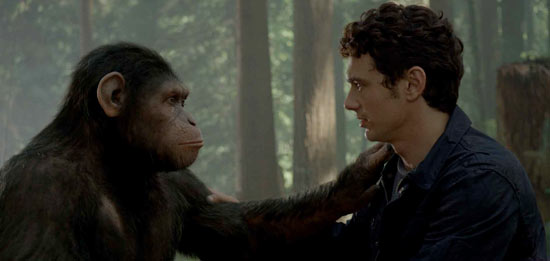
Serving as a prequel to the beloved 1968 sci-fi adventure Planet of the Apes starring Charlton Heston, ROTPOTA is set in present day San Francisco. Will Rodman is a geneticist on the verge of a medical breakthrough which will revolutionise modern medicine and rid the world of Alzheimer's disease. Motivated by purist thoughts and a need to stop his father from succumbing to the very illness, which he is seeking to eradicate, Will decides to conduct clinical trials on primates. Through a climactic opening act, which depicts the harsh environment of captivity, the tragic Doctor is forced to adopt Caesar; an ape, whose mother was killed in attempting to protect her offspring at the medical facility. Will forges an unlikely paternal relationship with the small chimp and begins to realise that Caesar displays an advanced form of intelligence, as a result of inherent genes passed on from his mother, who was subject to the clinical trials. Through Caesar's experiences and his ever-evolving knowledge of humans' interaction with his fellow kind, he decides to make a bid for freedom; inadvertently taking the first steps towards a revolution. As you will know from the events encompassing the rest of the saga, the motivations of the main protagonists lead to a world markedly different from our own and not one we'd wish to live in. Although, it doesn't necessarily reach that stage in this prequel, it's the sense of foreboding and dramatic irony, along with my opening quote in the back of your mind, that enrich and enhance this experience.
To write anymore of a plot synopsis is simply going to spoil what is, in my mind, one of the greatest blockbusters to hit cinemas this year. I've spent much of my film-going time this past six months bearing witness to adequate, yet by-the numbers, blockbuster fare. So it's certainly been refreshing to watch a film, which wraps itself in a modicum of intelligence, rather than bludgeon you to death with mindless explosions and dead-weight humour...... Yes, I am hinting that Michael Bay's transforming behemoth is akin to sticking your head in a washing machine full of hasbro toys, whilst also listening to an iPod compilation of different, albeit extremely mundane, bomb explosions.

"It's frustrating that the process isn't better understood. It's easy to understand John Hurt's role in The Elephant Man, for which he won an Oscar [nomination]. He had layers of incredible make-up but the underlying performance won him an Oscar [nomination]. Performance-capture is the same as that but the make-up is applied as pixels painted on to the actor later down the line. Any actor should be able to play this kind of role, it's just a case of embracing the technology."
This whole notion of fighting for one's freedom through adversity and hatred forms the core of Rupert Wyatt's Rise of the Planet of the Apes. However, to reduce this film to a simple political philosophy is to serve it a great injustice. Tackling themes from animal cruelty and the dual nature of captivity through to the role of family, bereavement and the nature versus nurture debate, ROTPOTA is simply in a class of its own. To steal a word, which has been emblazoned on the bottom of every blockbuster poster this summer, Wyatt's film is a marvel to behold.
Serving as a prequel to the beloved 1968 sci-fi adventure Planet of the Apes starring Charlton Heston, ROTPOTA is set in present day San Francisco. Will Rodman is a geneticist on the verge of a medical breakthrough which will revolutionise modern medicine and rid the world of Alzheimer's disease. Motivated by purist thoughts and a need to stop his father from succumbing to the very illness, which he is seeking to eradicate, Will decides to conduct clinical trials on primates. Through a climactic opening act, which depicts the harsh environment of captivity, the tragic Doctor is forced to adopt Caesar; an ape, whose mother was killed in attempting to protect her offspring at the medical facility. Will forges an unlikely paternal relationship with the small chimp and begins to realise that Caesar displays an advanced form of intelligence, as a result of inherent genes passed on from his mother, who was subject to the clinical trials. Through Caesar's experiences and his ever-evolving knowledge of humans' interaction with his fellow kind, he decides to make a bid for freedom; inadvertently taking the first steps towards a revolution. As you will know from the events encompassing the rest of the saga, the motivations of the main protagonists lead to a world markedly different from our own and not one we'd wish to live in. Although, it doesn't necessarily reach that stage in this prequel, it's the sense of foreboding and dramatic irony, along with my opening quote in the back of your mind, that enrich and enhance this experience.
To write anymore of a plot synopsis is simply going to spoil what is, in my mind, one of the greatest blockbusters to hit cinemas this year. I've spent much of my film-going time this past six months bearing witness to adequate, yet by-the numbers, blockbuster fare. So it's certainly been refreshing to watch a film, which wraps itself in a modicum of intelligence, rather than bludgeon you to death with mindless explosions and dead-weight humour...... Yes, I am hinting that Michael Bay's transforming behemoth is akin to sticking your head in a washing machine full of hasbro toys, whilst also listening to an iPod compilation of different, albeit extremely mundane, bomb explosions.
Andy Serkis as 'Caesar' in ROTPOTA.
First and foremost, the sole reason for anybody to waltz in to their local multiplex and watch this compelling tale of compassion, loss and liberation is Andy Serkis. What he has managed to achieve with Caesar is simply astounding. To display all of the vulnerabilities, sensibilities and, ultimately, strength emanating from this resolute primate is a staggering piece of work. By wrapping this ape's characteristics with humanity and warmth, Serkis has certainly left the Academy with no reason not to award him with a long overdue Oscar nomination. The 'stone age' film organisation has argued that his previous portrayal of Golem - and later King Kong - did not warrant the same level of merit in comparison to on-screen actors simply due to the misunderstood computer-generated veneer which was laid over his real actions. However, this is a sticking point with which the Academy is being criticised for by Serkis' on-screen brethren, as well as Serkis himself and rightly so. The ape-actor has recently been quoted as saying:
This technology is, quite simply, one future facet of the film industry. If Hollywood studio executives spent more time understanding and promoting the use of motion capture in film rather than over-saturating the market with cheap 3D technology, more production teams might be able to access the stellar tech put together by Weta Digital. In relation to ROTPOTA it is testament to Weta's work that you honestly forget the creatures on screen aren't real apes. This realism lends itself well to the story's narrative arc and helps root the series in a basis, which doesn't feel contrived or in any way 'far-fetched'. In fact, certain elements of the ape series (i.e. the apes' ability to communicate), which are explained in this prequel come across as shocking rather than predictable or expectant. This is simply due to the level of realism achieved using motion capture.
The ape-ape interaction drives the story forward in ways which could not be possible or feasible even a decade ago. During the ape sanctuary segment of the film, we witness how politics plays an integral role in these apes lives, as well as how Caesar rises from a pampered outsider to an unlikely champion and alpha-male amongst his fellow kind. This, all without speech. It truly is compelling viewing.
If there were any weak points to be identified - and there certainly are - one could deduce that the on-screen actors are up-staged by the apes. Only John Lithgow, as the traumatised Alzheimer's sufferer, and James Franco's doctor bring any sort of third dimension to the fore. Somewhat ironically this is mainly due to their interaction with Caesar. Of particular note is the formers emotional bond with the hyper-intelligent primate and his eventual acceptance that his disease will never leave him. I found it somewhat unusual that such emotional resonances would emerge from a summer blockbuster without feeling in any way 'cringe-worthy' or superficial.
However, it would appear the human-human interaction in Apes is one which is cast by the wayside. This is especially relevant to the relationship between Franco and Freida Pinto, who seems to play an all-together brighter version of 'Latika' from Slumdog Millionaire. Brian Cox plays the one-dimensional ape sanctuary manager; along with Tom Felton who personifies an even-more repulsive version of Draco Malfoy. One could argue that malicious keepers of their persuasion need only display aggression and distain, but it's seems a shame their motivations for this cruelty towards apes was in no way explored.

Given the well-orchestrated pace of ROTPOTA, the criticisms outlined previously may actually be irrelevant. Wyatt's direction is energetic and refreshing; blending the archetypes of a classic Spielbergian blockbuster with the tropes of a modern and ever-changing industrial beast. The infant director clearly has a deeply-held love for San Francisco and captures the allure and towering majesty of the Muir woods Redwood forest. I honestly had a moment of deja vu in watching those scenes, with Wyatt perfectly capturing the magic of visiting such a place.
Being such a fan of the original saga and an ardent hater of Tim Burton's dire re-imagining, I was somewhat, if not fully, sceptical that this prequel would be banished to the fiery pit of failure. Rise of the Planet of the Apes has, however, surpassed my lowly expectations in leaps and bounds. In this era of reboots and remakes, I find it deeply refreshing that a film has managed to pass through to the pantheon of rollicking entertainment with good intentions. It just seems a shame that the plethora of crap on offer at the cinema this year, although made with honest intentions, falls flat into the perpetual pits of Hades; with those lowly chimps, however, cackling from way up high.
The ape-ape interaction drives the story forward in ways which could not be possible or feasible even a decade ago. During the ape sanctuary segment of the film, we witness how politics plays an integral role in these apes lives, as well as how Caesar rises from a pampered outsider to an unlikely champion and alpha-male amongst his fellow kind. This, all without speech. It truly is compelling viewing.
If there were any weak points to be identified - and there certainly are - one could deduce that the on-screen actors are up-staged by the apes. Only John Lithgow, as the traumatised Alzheimer's sufferer, and James Franco's doctor bring any sort of third dimension to the fore. Somewhat ironically this is mainly due to their interaction with Caesar. Of particular note is the formers emotional bond with the hyper-intelligent primate and his eventual acceptance that his disease will never leave him. I found it somewhat unusual that such emotional resonances would emerge from a summer blockbuster without feeling in any way 'cringe-worthy' or superficial.
However, it would appear the human-human interaction in Apes is one which is cast by the wayside. This is especially relevant to the relationship between Franco and Freida Pinto, who seems to play an all-together brighter version of 'Latika' from Slumdog Millionaire. Brian Cox plays the one-dimensional ape sanctuary manager; along with Tom Felton who personifies an even-more repulsive version of Draco Malfoy. One could argue that malicious keepers of their persuasion need only display aggression and distain, but it's seems a shame their motivations for this cruelty towards apes was in no way explored.
Can anyone spot the ever-so subtle nod to the original 1968 film within this image??
Being such a fan of the original saga and an ardent hater of Tim Burton's dire re-imagining, I was somewhat, if not fully, sceptical that this prequel would be banished to the fiery pit of failure. Rise of the Planet of the Apes has, however, surpassed my lowly expectations in leaps and bounds. In this era of reboots and remakes, I find it deeply refreshing that a film has managed to pass through to the pantheon of rollicking entertainment with good intentions. It just seems a shame that the plethora of crap on offer at the cinema this year, although made with honest intentions, falls flat into the perpetual pits of Hades; with those lowly chimps, however, cackling from way up high.
